Monday, 10 February 2014

Cicadas, Christmas Beetles and Birds

It has been a summer dominated by cicadas and Christmas Beetles and the local eucalypts and corymbias are showing signs of stress.  Some trees have had most of their leaves consumed by beetles, mostly Christmas Beetles of the genus Anoplognathus, and some smaller trees such as the Red Ash and Creek Sandpaper Fig have been attacked by small beetles known as 'Jumping Beetles'. Christmas Beetles can cause much damage as their natural numbers can be exceeded in areas where forests have been cleared or partly cleared and lawns or grass paddocks have taken their place.  The larvae are the greyish curl grubs that feed on grass roots.  Because there is a greater supply of grass roots than was normal in the past more larvae survive and become adult beetles.  The unnaturally high numbers of adult beetles grazing on eucalypt leaves can strip trees bare.  The New England Dieback that has occurred on the NSW northern tablelands is thought to be due a number of impacts, but consumption of leaves by the beetles is a major cause.


Christmas Beetle Anoplognathus sp. 
 
Christmas Beetle Anoplognathus sp.

Black Nail Beetle Repsimus manicatus


'Christmas Beetle'
                                     

                                          Jumping Beetles on Creek Sandpaper Fig
                                                                   Coutts Crossing


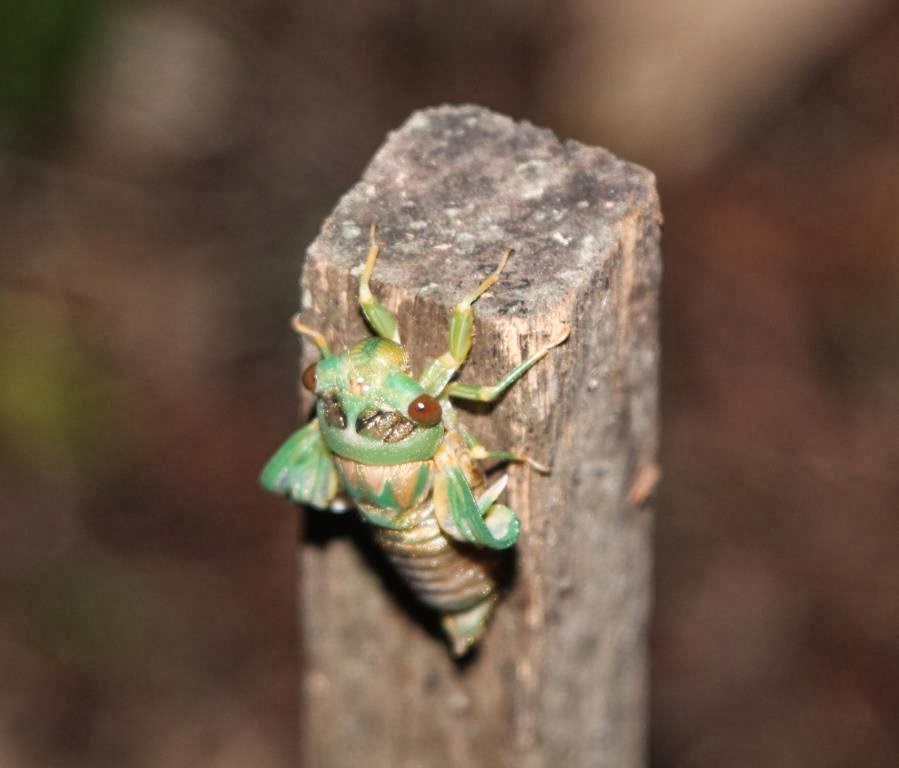
Up until a few days ago the incessant call of ciacdas was all pervading, even into the evening.  A number of species occur locally including the Yellow Monday Cyclochila australasiae ,  Razor Grinder Henicopsaltria eydouxii, Psaltoda pictibasis and others that I am having identified at present.  P. pictibasis is found east of the Great Dividing Range and in NSW there are records from only Tabulum, Iluka and Port Macquarie.  The latter locality requires confirmation.  So my record at Coutts Crossing is a new locality for the species. Cicadas emerge from the soil during the summer after spending years underground feeding on the sap from plant roots.  The larvae climb up onto tree trunks and other objects, and shed their nymphal cases (exuviae).  A small post at the edge of our driveway has a cluster of nymphal cases at the top. Once fully emerged and the wings open and dry out they fly to a tree to feed and breed.  


Psaltoda sp. cicada emerging from Nymphal case Coutts Crsossing


Cicada nymphal cases on stump Coutts Crossing


   Yellow Monday Cyclochila australasiae and
nymphal cases Ebor Falls
 
 
Cicada Psaltoda pictibasis Coutts Crossing 
 
 
Razor Grinder Henicopsaltria eydouxii  Orara River Coutts Crossing
 

                               Floury Baker Aleeta curvicosta Coutts Crossing


                       Double Drummer Thopha saccata Nymboi-Binderay National Park


Identifications provided so far have been by Ian Buddle, Max Moulds, Frank Pierce and Lindsay Popple .


For the past few mornings cicadas haven't dominated the sounds of the bush as they have been doing for some time.  The cooler weather seems to have quietened them down and the fact that they provide a rich source of food for many bird species means that their numbers may be dwindling due to predation.  For the past few mornings, the chattering of Spangled Drongos and the calls of Noisy Friarbirds, Little Friarbirds, Noisy Miners, Blue-faced Honeyeaters and Little Wattlebirds have dominated.  Large numbers of these birds have been feasting on the beetles and cicadas.  At least 10 Spangled Drongos, including dependent young being fed by adults, were present but as they are very active this estimate is probably understating the real number present.  A flock of 13 Blue-faced Honeyeaters and a number Noisy Friarbirds, including an adult feeding a juvenile, were also present.
A family of Pacific Bazas, an adult and juvenile Olive-backed Orioles and a couple of Dollarbirds have also joined in the feast.


Monday, 3 February 2014

A recent trip to Tucabia and Lawrence

I try to visit the local wetlands as often as possible to check up on our local Black-necked (Satin) Storks and to see what other wildlife is around.  Warren Thompson and I ventured to the Coldstream Wetlands, near Tucabia, and to Lawrence last Tuesday.  For a hot dry summer's day we were pleasantly surprised with our tally of species recording 116 birds, 4 mammals, 2 reptiles and one frog species.  Cicadas were ever present making it difficult to hear many bird calls.  It has also been suggested that the constant sound of cicadas causes many birds to remain silent although it would be hard to know if any were calling due to the noise.  In addition, by the time of the year that the cicadas are really going strongly, many birds would have finished breeding and calling may be reduced for this reason.

We started at Coutts Crossing, where we live, and travelled to South Grafton, where I had to drop off my vehicle for a service.  Warren was the driver for the day so I was happy to go where he wanted to go.   On the trip into town the flock of Magpie Geese were at the dam at the former poultry farm but I didn't stop to count them but conservatively estimated that there were 60+ present.  A few days later I counted 120+ at that site.  Adjacent to the Pacific Highway at Clarenza we found four more Magpie Geese perched in a dead tree.  There were also Grey Teal and Pacific Black Ducks there and an Australian Reed-Warbler and a Tawny Grassbird were calling.


Four Magpie Geese at Clarenza
We travelled up a back road at Clarenza and stopped near a small creek.  This site usually produces a good variety of birds and it didn't disappoint this time.  We added Rainbow Bee-eater, Dollarbird, White-throated Gerygone, Spangled Drongo (3), the vulnerable Varied Sittella (5) and twenty-one other species.  After photographing an adult male Brown Falcon we reached the wetlands at Swan Creek and began to add waterbird species such as Eurasian Coot, Hardhead, White-faced Heron and Australasian Grebe to our list.  We also heard Golden-headed Cisticola, which was present at many of the wetlands that we visited during the day.  


Adult male Brown Falcon


An adult Nankeen Night-Heron flushed from a thickly foliaged tree and landed in a dead tree.  While it was there a White-necked Heron landed in the same tree.  As they perched there the Night Heron was craning its neck and watching something high above.  When I looked up a pair of Wedge-tailed Eagles was gliding above.  They are always a great sight.  This would have been the pair that occupied the nest that a 'bird watcher' had fallen from and severely injured himself last year.

 
Adult Nankeen Night-Heron


Adult Nankeen Night-Heron watching Wedge-tailed Eagles


White-necked Heron
 
 
On to the Coldstream wetlands where we encountered our first Brolgas for the day.  There were five off towards Collett's Swamp and two near the Avenue Drain.   A sub-adult female Black-necked Stork was loafing on the edge of the drain where two Pacific Black Ducks, two White-necked Herons and a White-faced Heron were foraging. 


                             Sub-adult female Black-necked Stork with White-
                             necked Herons, White-faced Heron and Pacific
                             Black Ducks

The drain was covered with the native Giant Waterlily Nymphaea gigantea.


A visit to the northern section of the Crowsnest Swamp provided views of abundant birdlife congregating in the drying wetland.  A number of Eastern Great and Intermediate Egrets, Australian Pelicans, Pacific Black Ducks, 5 Australasian Shovelers, Grey Teal, Royal Spoonbills, 28 Glossy Ibis and a few Australian White Ibis were there.


                                  Mixed waterbirds at Crowsnest Swamp


We had lunch at a TSR on the Coldstream River and a few White-throated Needletails flew low overhead.  Then on to Tucabia to check out the flying-fox colony.  It was quite a sight with 5,000+ Little Red Flying-foxes camped in a reserve along the River.  It was great to see these much maligned, but incredible, animals up close. Unfortunately I heard on Sunday morning that a local had torched the camp last night and not only have the bats gone but the riparian vegetation is badly damaged.  This type of criminal behaviour is based on ignorance and fear.  The authorities are investigating this act of mindless vandalism.  Usually what happens in these situations is that the poor bats, that are struggling to find enough suitable habitat left for them, will be pushed into a location where there is more conflict with humans, as happened at Maclean.


Little Red Flying-fox colony at Tucabia


Little Red Flying-foxes
 
 
After a visit to the Lawrence egret colony swamp, where we observed 20+ Freckled Ducks, 36+  Pink-eared Ducks and a female Musk Duck we headed home along the Lawrence Road where we came across a flock of 21 Brolgas.  As I was photographing the Brolgas I notice a raptor in a dead tree.  It was a sub-adult Peregrine Falcon, moulting from its brown immature plumage to its grey adult plumage.  Five more Brolgas were seen a short distance further south.  An adult Eastern Osprey and a Brown Goshawk made the day's tally 116 bird species.


                                              Adult Brolga south of Lawrence


                                              Sub-adult Peregrine Falcon


We recorded 12 species that we didn't record on our two previous trips (on 14 & 21 November 2013) but dipped on 35 that we did get previously.  The total number of bird species recorded on the three days was 151.

The total list for 28 January 2014 is shown below with  ‘T’ = threatened, * = introduced; 

Birds: Magpie Goose (T), Plumed Whistling-Duck, Musk Duck, Freckled Duck (T), Black Swan,  Australian Wood Duck, Pink-eared Duck, Australasian Shoveler, Grey Teal, Chestnut Teal, Pacific Black Duck, Hardhead, Australasian Grebe, Hoary-headed Grebe, White-headed Pigeon, *Spotted Dove, Crested Pigeon, Peaceful Dove, Bar-shouldered Dove, White-throated Needletail, Australasian Darter, Little Pied Cormorant, Great Cormorant, Little Black Cormorant, Pied Cormorant, Australian Pelican, Black-necked Stork (T), White-necked Heron, Eastern Great Egret, Intermediate Egret, Cattle Egret, White-faced Heron, Little Egret, Nankeen Night-Heron, Glossy Ibis, Australian White Ibis, Straw-necked Ibis, Royal Spoonbill, Yellow-billed Spoonbill, Eastern Osprey (T), Black-shouldered Kite, White-bellied Sea-Eagle, Whistling Kite, Brown Goshawk, Swamp Harrier, Wedge-tailed Eagle, Nankeen Kestrel, Brown Falcon, Peregrine Falcon, Brolga (T), Purple Swamphen, Dusky Moorhen, Eurasian Coot, Black-winged Stilt, Black-fronted Dotterel, Red-kneed Dotterel, Masked Lapwing, Comb-crested Jacana (T), Caspian Tern, Crested Tern, Silver Gull, Yellow-tailed Black-Cockatoo, Little Corella, Sulphur-crested Cockatoo, Rainbow Lorikeet, Scaly-breasted Lorikeet, Musk Lorikeet, Australian King-Parrot, Eastern Rosella, Laughing Kookaburra, Sacred Kingfisher, Rainbow Bee-eater, Dollarbird, Superb Fairy-wren, White-throated Gerygone, Yellow-rumped Thornbill, Brown Thornbill, Lewin’s Honeyeater, Yellow-faced Honeyeater, Noisy Miner, Little Wattlebird,    Scarlet Honeyeater, Brown Honeyeater, White-throated Honeyeater, Blue-faced Honeyeater, Noisy Friarbird, Little Friarbird, Striped Honeyeater, Varied Sittella (T), Black-faced Cuckoo-shrike, Golden Whistler, Rufous Whistler, Australasian Figbird, Olive-backed Oriole, White-breasted Woodswallow, Grey Butcherbird, Pied Butcherbird, Australian Magpie, Spangled Drongo, Grey Fantail, Willie Wagtail, Torresian Crow, Magpie-lark, Jacky Winter, Golden-headed Cisticola, Australian Reed-Warbler, Tawny Grassbird, Little Grassbird, Welcome Swallow, Fairy Martin, Tree Martin, *Common Myna, Mistletoebird, Double-barred Finch, Red-browed Finch, *House Sparrow.

Mammals: Northern Brown Bandicoot, Eastern Grey Kangaroo, Red-necked Wallaby, Little Red Flying-fox.

Reptiles: Short-necked Turtle, Garden Sun-skink.

Amphibians: Eastern Dwarf Tree Frog.

Saturday, 1 February 2014

Elusive Rufous Scrub-birds very elusive

Following my recent post on our search for the elusive Rufous Scrub-bird in Gibraltar Range
National Park I received an email from Penny Drake-Brockman from Gloucester. 

She wrote "Interested to read your short report on search for the scrubbird in your
local range.  Maybe their not calling was due to the drought - is that
area very dry?  Hunter Bird group had little response from the
scrub-birds at Gloucester Tops this year (surveys in September/October)
and put this down to it being very dry - this has happened in the past.

I went up to Gloucester Tops mid November with some birders, and we only
heard the Munro Hut bird (which is the one that is usually most easily
heard) make a few chips, and one other further along the Careys Peak
Track - with no calls from many other previously recorded sites.   When
surveying up there in other years when we've had sufficient rain, I've
heard them loud and clear at many sites."

Penny is right about the rain.  We have had a particularly dry spring and summer.  We have had a few storms but many of the local wetlands have dried up. 

I am glad to know that it is not just the Gibraltar Range Scrub-birds that have been hard to locate.  Hopefully this is just a temporary glitch and they will be back to their vocally loud selves next year.


                                                    Rufous Scrub-bird habitat Gibraltar Range National Park

Thursday, 23 January 2014

In search of the elusive Rufous Scrub-bird

The Rufous Scrub-bird is one of the most elusive birds in the world.  Early collectors found it very difficult to secure specimens for museums as it was very difficult to shoot.  The bird moves through the leaf litter like a small mammal.  Because of its reclusive habits it has a very loud call which allows it to advise that its territory is occupied.  For this reason many bird watchers have heard a Rufous Scrub-bird but have not seen one.  This was the situation when last Friday I was searching for this species with two Queenslanders, Judy and Rae at Gibraltar Range National Park.  Although the species is not breeding at this time of the year I had expected to at least hear it, even if we couldn't see it.  It calls mostly during the spring breeding season but I have heard the species call throughout the year.  We visited four territories, the first close to the Gwydir Highway.  This was our regular Twitchathon bird but wasn't calling there at Twitchathon time although it was the prime time for calling then.  We were disappointed again on Friday as it was silent.  I tried some limited call playback but although a number of other species were singing their hearts out there was no Scrub-bird call to be heard.  On to the site where we did hear it on the Twitchathon and again no Scrub-bird calls.  The third site involved a short stroll along a walking track near Mulligans Camp and we were distracted by a good number of birds, including Brown and Striated Thornbills, Brown Gerygone, Golden Whistler, New Holland Honeyeater and Musk Lorikeet. A flock of five Topknot Pigeons flew high above the canopy obviously searching out a fruiting rainforest tree.  We arrived at the Scrub-bird site and I found an edge with the correct type of vegetation structure so played the call.  We heard a faint response but it was hard to distinguish it among all of the other calls, including those of the Eastern Whipbird, Brown Gerygone and Eastern Spinebill.   Then I glimpsed it, a small brown flash, checking out the playback speaker.  "Over here" I beckoned but it was too late.  It had disappeared into the ether and didn't make a comeback.  We had great views, and photo opportunities, of an adult Black-faced Monarch at Mulligan's Camp.  On to site four which involved a short walk from the road down to a beautiful forest dominated by very tall Messmate Stringybarks.  The Messmate was the first eucalypt species described by botanist, Charles-Louis L'Heritier de Brutelle, a French minor aristocrat, in 1788 (Australian Eucalypts by Mervyn Millet 1969).  On our return trip we checked out the second site again but still no Scrub-bird.  I did find a Yellow-throated Scrubwren nest with two advanced nestlings though.  The trip down the Range resulted in views of a number of Satin Bowerbirds, a couple of Bassian Thrushes and some Brown Cuckoo-Doves.  Although Judy and Rae didn't see the target species they said that they really enjoyed the morning and that it is a wonderful area.  I would have to agree with them.


Adult Black-faced Monarch Mulligans Camp Gibraltar Range NP


Views from Raspberry Lookout, Gibraltar Range National Park


Tuesday, 21 January 2014

Weekend in Coffs Harbour

Family commitments saw me spend the weekend in a cabin at the Park Beach Holiday Park at Coffs Harbour.  Not really being one for crowds it was a little hard to take but the special time that I had with three of my nine grandchildren made it worthwhile.  Koby, the five year old veteran of two Gould League Bird Camps, was very keen to check out the field guide and always presents me with feathers that he collects.  This time it was a Magpie-lark tail feather.  The only other birds that were seen or heard were common species including the Masked Lapwing, Noisy Miner, Blue-faced Honeyeater, Silver Gull, Torresian Crow and  Eastern Koel.  I heard a number of individuals of the introduced Asian House Gecko around the park.  A late afternoon walk to Park Beach allowed views of Muttonbird Island, Little Mutton Island, Split Solitary Island and South Solitary Island.

South Solitary Island (in distance) and Split Solitary Island viewed from Park Beach

Sunday, 12 January 2014

Boobook family visits Coutts Crossing backyard


On December 4 2012 I heard a Southern Boobook calling at night near our home at Coutts Crossing, north coast New South Wales, Australia.  On December 6 a pair of Little Friarbirds was jumping around on the branches of a Macadamia Nut tree in our backyard, harassing an adult Boobook.  As I went to investigate the commotion I flushed the owl which flew to a tree in our front yard.  The Little Friarbirds were joined by some Blue-faced Honeyeaters, a pair of Magpie-larks and some Noisy Miners.  
Adult Boobook being harassed by Little Friarbird 06.12.12
 
It, or another adult, was also present on December 9 roosting in a Queen Palm next to our backyard with Australian Magpies, Grey Butcherbirds and Torresian Crows all nearby calling in alarm. A single adult was present in our yard almost daily from December 19 to 26.  Then on December 31 there were two adults roosting in the thick foliage of the paperbarks in the backyard.  The noisy activity of the sentinel honeyeaters drew my attention to a Forest Red Gum Eucalyptus tereticornis in the backyard to the rear of our place.  There I observed a fluffy juvenile Boobook.  It was joined 20 minutes later by a second juvenile.
Adult pair in yard 31.12.12
                                                             Adult in yard 31.12.12


                                                                 Juvenile on 31.12.12


                                                               Two juveniles on 31.12.12
 
On December 3 2013 the Boobooks were back.  Three birds, an adult and two downy juveniles, arrived in the yard at 1955 hrs.  The juveniles were making insect like sounds and this prompted the adult to flew over the house and into nearby bushland, obviously to hunt for food.  I tried for a couple of photos but the light was poor so wasn’t that successful. 
                                                               Adult on 03.12.13
 
                                                                 Juvenile on 03.12.13
 
Four birds, two adults and two juveniles, were in the yard for the whole of the next two days being occasionally harassed by the very vocal honeyeaters and other birds.  I was able to get some better photographs.
 
Family of four on 04.12.13
 
 
Adult on 04.12.13


Adult on 04.12.13


Two juveniles on 04.12.13


                                                        Juvenile on 04.12.13

  They didn’t return to the yard after that but a juvenile was found alone in a park near our place       
  a couple of days later.  It flew to the ground when approached so was taken into care                         
 for  its own protection.  A search for the adults proved futile.  If the adults had been found                 
 the youngster would have been released with them.  The juvenile was placed in a carer’s aviary        with two other Boobooks of similar age.   I placed a numbered stainless steel band on the leg          of each of these birds on January 9 and released the Coutts Crossing bird that evening.                    It flew off strongly and swiftly and disappeared into the darkness.  The other birds were from         Waterview Heights and South Grafton and will be released close to where they were found.                                                                            


                        Coutts Crossing juvenile with red temporary bangle 09/01/14


                                           Coutts Crossing juvenile on right 09/01/14


I could hear an adult Southern Boobook calling close to home two nights later so hopefully the young bird will reconnect with its parents or be able to fend successfully for itself.  It was feeding itself well in captivity.

I look forward to the December 2014 visit of our Southern Boobook family.