Sunday, 14 December 2014

The declining Coastal Emu


Adult Coastal Emu Diggers Camp Road, Yuraygir National Park


Emus once occurred along much of the New South Wales Coastline and adjacent areas with Emu Plains west of Sydney being an example of where they were found in early days of European settlement.  The only Emus that have occurred at Emu Plains in living memory were a couple that escaped from the Butterfly Farm at Wilberforce some years back.  There are occasional reports of the species on the far south coast, which may involve birds re-introduced to the area, but in recent decades most coastal records have been made on the North Coast.  During the late 20th century they occurred at Port Stephens and in an almost continual band from Broadwater National Park near Evans Head through Bundjalung National Park to the southern tip of Yuraygir National Park at Red Rock with a few birds being found south of the Corindi River.  They also occurred south-west of Grafton in the Halfway Creek-Lanitza area and between Grafton and Casino, at Main Camp and Bungawalbyn.  I also observed two at Braunstone in the late1970s-early 1980s.  There have been other scattered records, such as at Valla, but some of these may refer to escaped or released birds from former Emu farms.  A couple of birds at Main Camp, Bungawalbyn, have had yellow, instead of blue, coloration to the head.  It was suggested by the Emu guru Stephen Davies that the birds may have had a constriction in the neck limiting blood flow but other explanations, such as diet and genetic mutation are more likely as the birds showed no signs of illness or distress.


Adult Coastal Emus Bungawalbyn

The species has disappeared from Port Stephens and has declined greatly in the parks between Red Rock and Broadwater, being locally extinct in Broadwater National Park and now extremely rare and close to extinction in Bundjalung National Park.  The population centred around Yuraygir National Park and at Bungawalbyn are the only viable populations remaining.  For this reason the local population has been listed as an endangered population under the NSW Threatened Species Conservation Act.  There are a number of threats to the species including motor vehicles, habitat destruction, too frequent or too hot fires, back-burning during bushfires and predators.  It is thought that feral pigs, foxes and wild dogs prey on eggs and young.  Although I am sure that feral predators are having an impact there is little specific data to indicate which of them are causing the problems or whether they all are.  I am a little sceptical about the idea that Dingoes are the problem as they have co-existed with the Emu for many thousands of years and Dingoes tend to feed on a variety of prey and generally don't find a single food source and feed on it until it is depleted as foxes seem to do.  The last birds occurring at Red Rock, south of the Corindi River, were reportedly killed by roaming domestic dogs.

Coastal Emu with yellow, instead of blue, on head, Main Camp, Bungawalbyn


In an attempt to gather more data on diet and threats to the Coastal Emu Russell Jago and I have been carrying out fortnightly surveys funded by Clarence Landcare with a grant from the Norman Wettenhall Foundation.  Fortnightly surveys are far from ideal but we are gathering some data on the biology and ecology of the species of four sub-populations in the Clarence Valley.

The distinctive footprint of an Emu photographed on the first survey in July

However at a time when the population has declined severely due to the impacts mentioned above we now have a human induced impact that is likely to disrupt the species further.  The preferred route of the Pacific Highway upgrade east of Grafton will cut a swathe through the remaining Coastal Emu habitat, as well as impacting on over 80 other threatened flora and fauna species.  There is an alternative route that skirts to the west of the Emu habitat and has very minor impacts on other threatened species but the Roads and Maritime Services (RMS) of New South Wales refuses to consider it as it is (supposedly) more costly and has a greater social impact.  I have petitioned the state Minister for the Environment, Rob Stokes, with an e-petition which has, to date, gathered over 8,500 signatures.  Many more will be needed to make the politicians and bureaucrats listen so if you haven't already signed it please do so now.  The link is: http://www.thepetitionsite.com/768/595/306/save-the-coastal-emu/#


Adult female Coastal Emu Taloumbi

Monday, 8 September 2014

Additional photos from the Tewantin, Queensland, trip


The following photos were taken on the return trip from Tewantin in July2014.  The first photos were taken near Buckley's Hole on Bribie Island.  The last at North Lakes.  Both sites are in southern Queensland.


Adult Gull-billed Tern in non-breeding plumage, Bribie Island
 
Common Tern in non-breeding plumage, Bribie Island
 
Adult Australian White Ibis, Bribie Island
 
Adult Australian White Ibis
 

Head shot of adult Australian White Ibis
 

Neck and breast plumes Australian White Ibis

Black and white mottled tertial feathers, Australian White Ibis
 
Adult Australian Pied Oystercatcher, Bribie Island

Adult Black-winged Stilt, Bribie Island
 
Australian Little Bittern skulking in reeds, North Lakes, Qld
 

Sunday, 7 September 2014

A July trip to Tewantin, Queensland


My brother Michael turned 60 in August but as he was helping to organise the elections in Fiji on his birthday it was decided to have an early birthday luncheon in July.  As I have rarely been north of Brisbane I was looking forward to trip for family reasons but also with anticipated ornithological results.  There were reports of Yellow and Australian Little Bitterns and an Asiatic Dowitcher in southern Queensland published on Birding-aus and, although I am not an avid twitcher, I am always happy to see new species.  We stayed in a 'villa' at Tewantin which was really an average cabin but that suited us well.  It had built in Black Ducks which greeted us as we arrived.  I suspect that previous guests had fed the birds as they were knocking at the door wanting to come in.  I am totally opposed to feeding wildlife as it has a number of negative impacts on the wildlife itself.  It is usually done more for the enjoyment of humans rather than the benefit of the wildlife.  Despite this view I did take the opportunity to photograph the Ducks at close range.  They are really handsome birds.


Pacific Black Ducks knocking at the cabin door

During our barbeque lunch at Noosa I photographed a Little Black Cormorant loafing on a small pier.  Cormorants really know how to relax in the sun.


Little Black Cormorant relaxing on pier
 

On Sunday morning Val and I visited Noosa National Park and found that just negotiating the car park required vast doses of Valium and some counselling.  So many vehicles with so few car parking spaces.  The sad part was that very few people were there for the national park values, unlike us.  Most were there for the surf!!!


View from the walk at Noosa National Park

Adult Grey Butcherbird, Noosa National Park

Noosa National Park

Noosa National Park

We had an enjoyable lunch on the Sunday and headed back south on the Monday.  Our first stop was Bribie Island and the famous Buckley's Hole Reserve.  I had heard about Buckley's many times as a number of Australian Pied Oystercatchers that I had banded and flagged in northern New South wales have been observed there.  Then back to Toorbul roost where the Asiatic Dowitcher had been seen.


Adult Caspian Tern at Bribie Island  with band and flag placed on it in Victoria

Immature Pied Butcherbird Bribie Island
Adult White-faced Heron, Bribie Island

We didn't find the Dowitcher at Toorbul but did see a number of Black-winged Stilts, Eastern Curlews, Bar-tailed Godwits and two green flagged Australian Pied Oystercatchers.
 

Little Egret, Bribie Island


Adult Black-winged Stilts with one immature bird and a Bar-tailed Godwit Toorbul


Australian Little Bittern North Lakes, Queensland

 
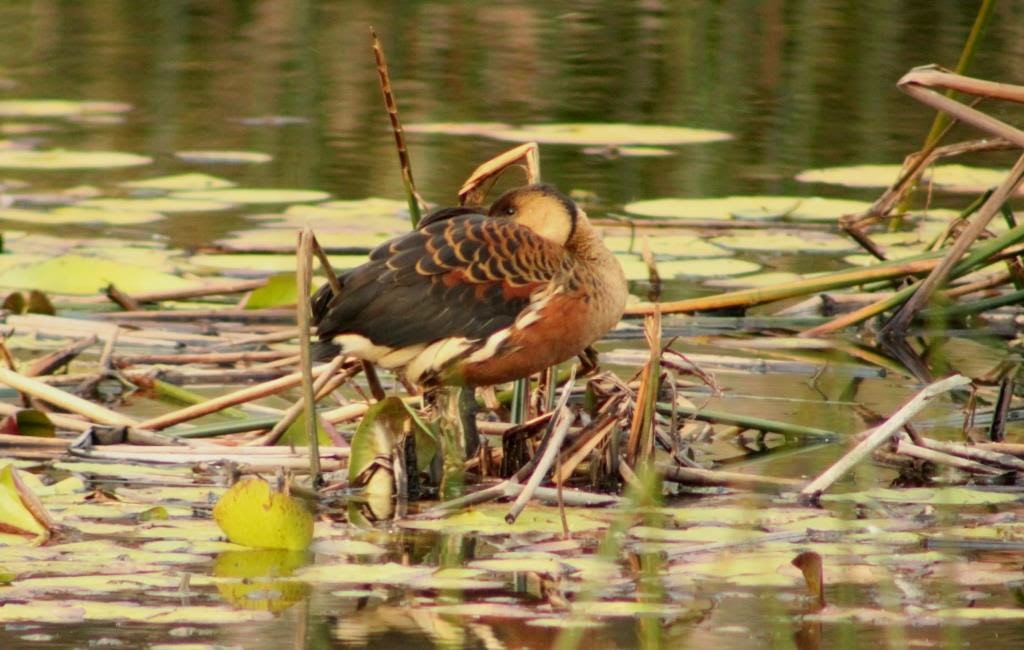
Having read about the Yellow Bittern being observed at North Lakes we decided to call in on our way home.  We met up with a small group of birdos who informed us that the Yellow Bittern hadn't been seen for about four days however the Australian Little Bittern was seen a few minutes before.  I had banded an adult male Little Bittern found in a backyard in Lawrence many years ago and saw a dead one that had been killed by a motor vehicle on Woodford Island, Clarence Valley, NSW but had never observed one in the wild.  After a patient wait I was rewarded with reasonable sightings but as it was on the far side of the wetland my photos were only average.  Despite this I was very happy to see one in the wild and to admire its beautiful colours.  A lone Wandering Whistling-Duck also graced the pond.
 
All in all a great combination of catching up with seldom seen family and observing and photographing some great birds.


Wandering Whistling-duck North Lakes


Saturday, 30 August 2014

More photos from the July Susan Island banding

The following are some additional photos taken on Susan Island during the July banding trip.


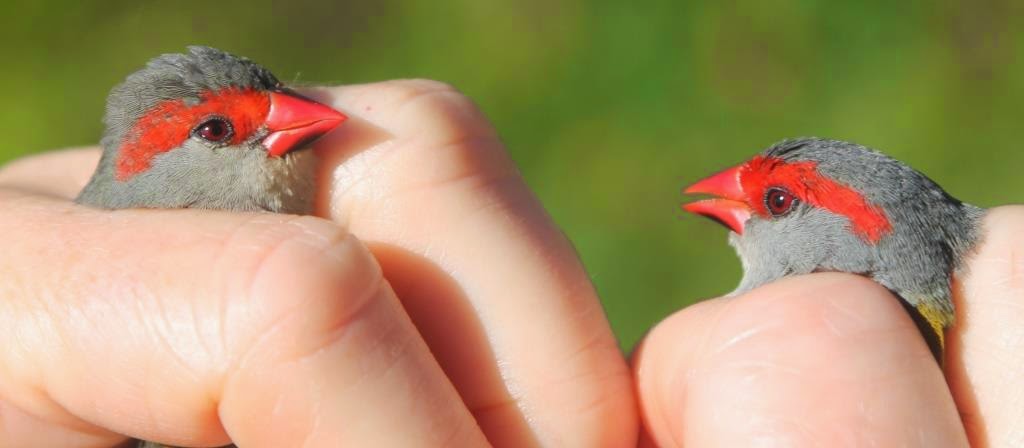
Red-browed Finch adult female on left adult male on right
Mostly black tail of adult male Golden Whistler
Adult male White-browed Scrubwren
Adult female Superb Fairy-wren

Golden Whistler in its second year or older
Adult female Grey Shrike-thrush
Adult Brown Thornbill
Adult Grey Fantail
Darkling Beetle
Yellow feathers on underparts of adult female Golden Whistler

 
Adult Little Shrike-thrush

Immature White-necked Heron in flight


Tuesday, 26 August 2014

Bird banding on Susan Island 21-22 June and 26-28 July 2014

Susan Island is an island in the Clarence River at Grafton, north coast NSW, and contains the largest remnant of lowland subtropical (dry) rainforest on the Clarence floodplain.  It has great ecological and cultural significance being an aboriginal women's place.

Wendy completing data cards


Bird Banding was carried out at the eastern end of Susan Island on 21-22 June and at the western end on 26-28 July 2014.  In June I was the only bander with Andrew Tarrant, Bill O'Donnell and Jess Smidt assisting.  In July Bill Greenlees, Wendy and Alan Pilkington and I banded while Andrew Tarrant assisted on the Saturday. 
 
Mist net set in powerline easement

'whistler' net near camp


One hundred and fifty-seven birds were mist netted over the five days, 14 on 21 June, 23 on 22 June, 41 on 26 July, 53 on 27 July and 26 on July 28. One hundred and twenty-five were new birds and thirty-two were retraps.    

The results are shown in the table below.


SPECIES
21/06
22/06
26/07
27/07
28/7
TOTAL
 
Band Ret
Band  Ret
Band  Ret
Band Ret
Band Ret
B       R
Laughing Kookaburra
 
  0      0
 
  1    0
 
   0      0
 
0     0
 
  0
 
 1      0
Grey Fantail
    
  0      0
     
  0    0
  
   0      0
 
1     0
 
 1    0
 
 2      0
Eastern Yellow Robin
    
 
  0      0
     
 
  0    0
   
 
   7      3        
 
 
1     2
 
 
 0    1
   
 
 8      6
Golden Whistler
 
  0      0
     
  1    0
                    
   7     2                               
 
 8    6
 
3     3
 
19   11
Grey Shrike-thrush
 
 
  0      0
 
 
  0    0
 
 
   3      0    
 
 
 0    0
 
 
 0    0
 
 
  3     0
Little Shrike-thrush
 
 
  0     0
 
 
  0    0
 
 
   0      0    
 
 
 0    0
 
 
 1    0
 
 
  1     0
Brown Thornbill
 
 0    0          
 
  0   0     
 
   1      0
 
 0    0
 
 1    0
 
  2     0
White-browed Scrubwren
 
 
  0     0
 
 
   0      0
 
 
   0      0
 
 
0     0
 
 
1     0
 
 
  1     0
Large-billed Scrubwren
 
  0    0        
 
  
  0      0
 
  
   1      1     
 
  
0     0
 
  
0     0
 
 
  1     1
Tawny Grassbird
 
  0     0
 
   3      0
 
   0      0
 
0     0
 
0    0 
 
  3     0
Superb
Fairy-wren
 
  7     0
 
  1       0           
                     
   0      0
 
1     0
 
1     1
 
 10    1
Silvereye
  0     0
   0      0
   4      0
13   1
2     0
 19    1
Lewin’s Honeyeater
 
  0     0
 
   2      0
               
   9      3
 
 7    5
 
3     4
 
 21  12
Red-browed Finch
 
 
  7     0
 
 
15       0
 
 
   0      0
 
 
7     0
 
 
4     0
 
 
 33    0
Striated Pardalote
 
  0     0
 
  0       0
 
   0      0
 
1     0
 
0     0
 
   1    0
TOTALS
14     0  
23       0
 32      9  
39 14
17   9
125 32       


Striated (Black-headed) Pardalote


The Striated Pardalote was the first one ever banded on the Island.  A high percentage (20.9%) of all birds caught were retraps.  The 33 retraps comprised 6 retraps of 5 different Eastern Yellow Robins, 12 retraps of 10 Golden Whistlers, 1 Large-billed Scrubwren, 1 Superb Fairy-wren, 1 Silvereye, and 12 retraps of 10 different Lewin’s Honeyeaters.

 
The dates of original banding of these retraps were as follows: 

 Eastern Yellow Robin: 26/05/11, 29/05/11, 28/07/12, 30/07/12, 26/07/14.

Golden Whistler: 27/10/08, 28/05/11, 29/07/12, 26/07/14, 27/07/14.

Large-billed Scrubwren: 26/06/10

Superb Fairy-wren: 27/07/14

Silvereye: 26/06/10

Lewin’s Honeyeater: 30/08/09, 28/06/10, 28/05/11, 26/07/14, 27/07/14. 

 
Adult male Eastern Yellow Robin

While a small number of these retraps were from a day or two earlier most were at least two years from banding and some as long as 6+ years since banding. 

 
Adult male Golden Whistler


Adult male Golden Whistler with Victorian tail colour

Twelve of the Golden Whistlers caught had tail wing ratios indicating that they were Tasmanian birds, 2 were locals and 8 were in the overlap zone of measurements meaning that they could be Tasmanian or local birds or from areas in between.  One adult male with a Victorian type upper tail colouration was in the overlap zone and one with similar tail colouration was within the range of Tasmanian birds.  A female plumaged bird with a Tasmanian ratio had whitish undertail coverts and vent which is a Tasmanian character however another with a similar ratio had yellow undertail coverts and vent (a mainland character).  The two Grey Fantails were Tasmanian birds based on tail-wing ratios. Six of the Silvereyes were ‘A’ type (race cornwalli) from the area between Sydney and central Queensland), 3 were A-B type (from central NSW), one was B type (southern NSW-Victoria, race westernensis) and one was a B-D type (Victoria-Tasmania) (between race westernensis and lateralis.

 
Female plumaged Golden Whistler with white undertail coverts

The banding and observations of the White-browed Scrubwren, Large-billed Scrubwren, Little Shrike-thrush, Eastern Yellow Robin and Tawny Grassbird are all significant.  Prior to 1997 cattle were grazed on the Island.  Up till then there had been only a few observational records of the Eastern Yellow Robin and Tawny Grassbird.  Since the cattle were removed both species have been recorded on almost every visit to the Island and 40 Yellow Robins have been banded since 2008, with a number of retraps being made, and 21 Grassbirds have been banded since 1998.  The first White-browed Scrubwren was mist-netted on the Island by Dominique Potvin in 2009.  She didn’t band it as she was only licenced to band Silvereyes.  The first one banded on the Island was in September 2011 so the one banded in July this year is only the second banded on the Island.  The first banding of a Large-billed Scrubwren on the Island was in August 2009 and there have now been 5 banded with a couple of retraps. This is a testimony to the value of removing stock from the Island and the great work that the Susan & Elizabeth Islands Trust and the National Parks & Wildlife Service have done in association with contractors such as Envite and volunteers.  Even the proliferation of weeds has helped the recovery of the bird populations.  Stands of weeds such as Wild Tobacco, Castor Oil Plant, and a variety of annuals, which don’t threaten the native plants, provide cover for a variety of birds.  The biggest threats to the native plants are the introduced vine weeds which mostly hail from South America.  There is ongoing work to control them.

 
A-B Silvereye showing rich buff flanks

A great variety of birds, a few mammals and two reptiles were observed or heard.  Two Spangled Drongos chased a Black-faced Cuckoo-shrike, which was carrying food in its bill, out over the waters of the Clarence River.  One bird flew back but the other actively pursued the Cuckoo-shrike.  I have previously observed and written about this kleptoparasitism in the Spangled Drongo.  An adult Peregrine Falcon was perched in a large Forest Red Gum on both days in June.  During the July banding one was observed to alight on a tall power pole at Grafton, just north of the Island.  A grey morph Grey Goshawk was seen on both trips.  When transporting gear back to Grafton on July 28 we saw a Square-tailed Kite soaring low over the trees and buildings near the main street.

 
Immature White-necked Heron


The full species list for the two visits is presented below:


Mammals

 
Grey-headed Flying-fox

Grey-headed Flying-fox
Black Flying-fox
Fox (June only – two were baited before July trip)
                                                                                                                        
Reptiles

Garden Sun-skink
Red-bellied Black Snake
                                                       
Birds

Australian Wood Duck                                           
Pacific Black Duck                                                 
Australasian Grebe                                               
White-headed Pigeon                                            
*Spotted Dove                                                         
Bar-shouldered Dove
Australasian Darter
Little Pied Cormorant
Great Cormorant
Little Black Cormorant                                            
Pied Cormorant
Australian Pelican                                                  
White-necked Heron
Eastern Great Egret                                    
White-faced Heron                                                 
Australian White Ibis                                              
Straw-necked Ibis                                                   
Royal Spoonbill
Eastern Osprey                                                       
White-bellied Sea-Eagle                                       
Whistling Kite                                                          
Brahminy Kite
Brown Goshawk                                                     
Grey Goshawk                                                         
Peregrine Falcon                            
Dusky Moorhen                                                      
Black-shouldered Lapwing                                                           
Australian Gull-billed Tern                                                            
Silver Gull                                                                
Galah                                                                        
Little Corella                                                             
Rainbow Lorikeet                                                    
Scaly-breasted Lorikeet                                         
Shining Bronze-Cuckoo
Laughing Kookaburra
Rainbow Bee-eater
Noisy Pitta
Superb Fairy-wren
Red-backed Fairy-wren
White-browed Scrubwren
Large-billed Scrubwren
Brown Gerygone
Brown Thornbill
Spotted Pardalote                                                                           
Striated Pardalote
Eastern Spinebill
Lewin’s Honeyeater
Yellow-faced Honeyeater
Brown Honeyeater
Noisy Friarbird
Black-faced Cuckoo-shrike
Varied Triller
Golden Whistler
Rufous Whistler
Little Shrike-thrush
Grey Shrike-thrush
Australasian Figbird
Pied Butcherbird
Australian Magpie
Pied Currawong
Spangled Drongo
Grey Fantail
Willie Wagtail
Torresian Crow
Rose Robin
Eastern Yellow Robin
Tawny Grassbird
Silvereye
Mistletoebird
Tree Martin
Red-browed Finch


Adult Brahminy Kite perched in Forest Red Gum near camp